
In home improvement retail, shoppers move fast, and store associates have little time for merchandising. A PDQ display gives brands a simple and effective way to get products on the floor quickly while also elevating visibility. A strong PDQ does more than hold product. It speeds up replenishment, improves shopability, and helps your brand stand out in busy aisles at The Home Depot, Lowe’s and other home improvement retailers.
This article explores what makes a PDQ work, how structural choices influence performance and how thoughtful graphic design can turn a functional tray into a retail advantage.
What Is a PDQ, and Why Does it Matter?
A PDQ is a retail-ready display that arrives at the store pre-assembled and often pre-stocked with merchandise. The term is commonly known to mean “product displayed quickly” or, more informally, “pretty darn quick”. The name captures its purpose. These displays eliminate the time-consuming task of in-store assembly, allowing associates to place the tray on a shelf or quarter pallet and start selling almost immediately.
In home improvement stores – where shelves are deep, products can be heavy and replenishment takes time – PDQs reduce the labor required to stock individual items. They keep products contained, organized and visible, which improves the shopper experience and supports better store execution.
PDQs matter because they:
- Speed up replenishment and reduce the labor costs of stocking all the product by hand
- Keep products clean, contained and easy to shop
- Improve merchandising consistency across stores
- Reduce shipping costs as the PDQ often doubles as the shipping box, which cuts out additional packaging and lowers freight and handling expenses
- Give brands a simple way to tell a visual story
Their true value goes beyond convenience. Because PDQs are self-contained units, they separate products from shelf clutter and create a dedicated home for your merchandise. This spotlight effect draws the shopper’s eye, encourages interaction and positions the product as a clear solution in the aisle. Whether placed on a shelf, a quarter pallet or a countertop, a PDQ becomes a mini billboard that communicates quickly and effectively.
A well-designed PDQ can become a grab-and-go solution for retailers and a silent salesperson for brands.
Understanding PDQ Structures
A successful PDQ program requires thoughtful planning, from tray structure and size to graphic design and final rollout. When executed well, it becomes a powerful tool for product launches, seasonal campaigns and promotional moments where immediate impact matters.
While PDQs vary in size and shape, two primary tray types dominate home improvement retail. Understanding the difference helps brands choose the right approach for strength, cost and appearance.
Perforated One-Piece Trays
These trays are made from a single piece of cardboard with a perforated top used for shipping that is then removed in-store. They are cost-effective, simple to manufacture and easy for associates to set up. The tradeoff is that once the top is torn away, the remaining tray often has a raw edge which may look less polished for premium brands.

Two-Piece or Stadium-Style Trays
These trays have a separate top and bottom base. The shipping top is removed in-store, and the bottom remains as the display tray. A stadium tray may have a raw, clean edge or a rolled edge where the cardboard folds back into itself for a cleaner, stronger finish.
Two-piece trays can offer a more premium look, better durability and cleaner presentation, especially for heavier or higher value items.

Rightsizing Your PDQ
The size of the PDQ tray directly affects how the product presents on the shelf. Brands often miss the opportunity to optimize footprint, especially when multiple SKUs are involved.
To improve consistency and reduce production complexity:
- Identify the common denominator size across SKUs.
- Minimize the number of tray sizes if possible.
- Keep front-facing heights consistent to create a unified “water line”.
- Avoid oversized trays that waste valuable shelf space.
A well-sized tray keeps inventory tidy and helps the shopper visually process products quickly.
Printing Options Explained
How you print your PDQ influences cost, color, accuracy and overall presentation. Direct-print places artwork directly on the cardboard, which keeps production simple and cost-effective. It’s quick and works well for basic graphic styles, although color consistency may vary, and detailed photography may not reproduce as sharply.
A sticker or label provides a more premium finish with stronger color accuracy and sharper reproduction of photography and gradients. This approach is ideal when the PDQ needs to match brand colors exactly, or when photography must look crisp. The tradeoff is a longer production timeline and higher cost, particularly if labels and trays are produced by different partners.
Choosing the right method depends on budget, timing and how important perfect color fidelity is for the product being displayed.
Designing Graphics that Sell
PDQs follow the same communication rules as packaging. The design must answer the shopper’s questions quickly while staying visually clean.
Aim for:
- A clear hierarchy that communicates who the product is for, and what it does
- A small set of key attributes that reinforce value
- High-quality photography that supports quick decision-making
- Intentional color choices since color is the first thing shoppers notice
- Design that complements the packaging, not competes with it
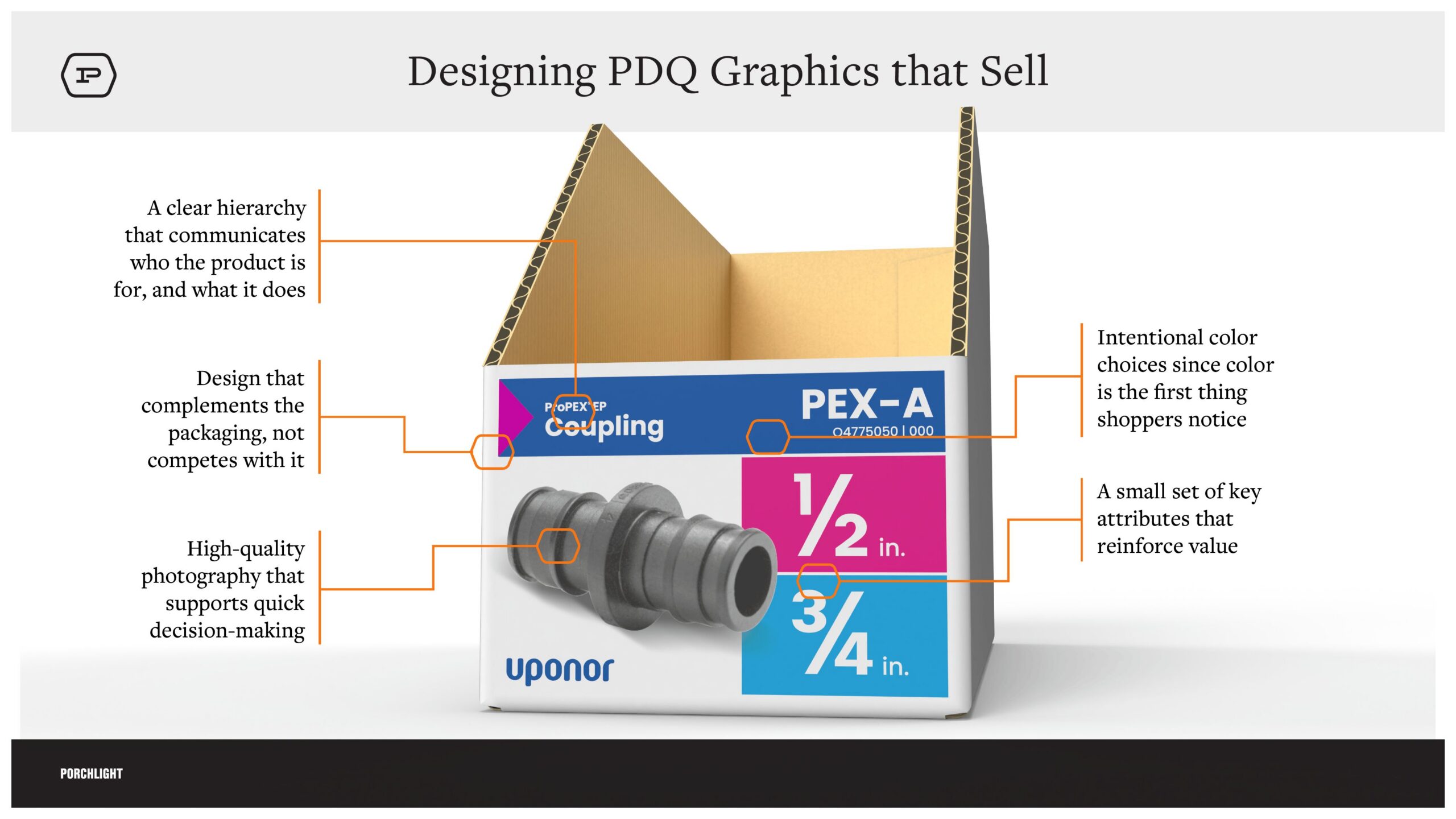
Avoid overloading the tray with copy. A PDQ is not a brochure. Its job is to highlight the product fast. The same best practices that guide strong packaging design apply here. Keep messages focused, use photography with intention and make sure hierarchy is clear. For more guidance on packaging principles that also strengthen PDQs, see our article on product packaging best practices.
Porchlight’s Perspective
A PDQ is one of the most efficient tools a home improvement brand can use to stand out in-store. When designed well, it improves stocking efficiency, enhances product visibility and elevates the shopper experience. Whether you are launching a new item or refreshing an existing line, a thoughtful PDQ strategy can increase conversion and support retail partners.
If you want help designing PDQs that work harder for your brand, we would love to collaborate.