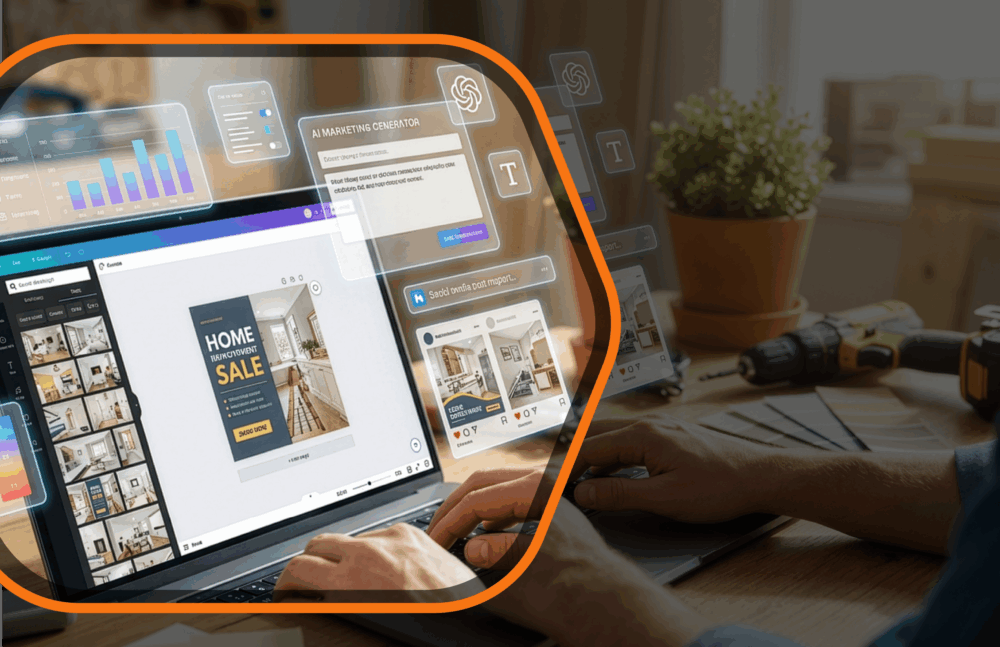
Artificial Intelligence (AI) in Our Everyday Work
Artificial intelligence once felt like something on the horizon. Today, it already shapes how we work, create and connect. In marketing, AI tools help teams sort through information faster, spot patterns, and support more relevant content and campaign decisions.
At Porchlight, we treat AI as a helper not a replacement. It gives us new ways to explore ideas and improve efficiency, and we pair that with the home improvement expertise and creative judgment our clients count on.
How We’re Using AI Today
AI has become a practical extension of our team. It supports the work we already do and gives us more time for strategy, storytelling and collaboration. Here are some of the ways it shows up in our day-to-day operations:
Research and Insights
- We use AI tools to scan large volumes of industry data and reporting. They help us quickly surface audience trends, behavioral shifts and emerging topics in the home improvement market. Our strategists then interpret those signals, pressure-test them against what we see from retailers and Pros, and translate them into insights our clients can act on.
Content Strategy and Ideation
- AI is part of our brainstorming toolkit. We use it to explore angles for blogs, social content, and email themes and to gather directional SEO keyword ideas. It helps us test different ways to talk to very different audiences – from busy Pros to first-time DIYers – and to see which messages might resonate.
- We never copy and paste what a tool suggests. Instead, we use those prompts to jump-start thinking, then refine the final copy so it sounds like our clients and reflects what their shoppers need.
Image and Asset Support
- On the creative side, AI helps with smaller, time-consuming tasks. We use it for light image cleanup, upscaling and generative expansion so layouts fit new sizes without starting from scratch. That kind of support work frees up our designers to spend more time on concepting, hierarchy, storytelling, and all the details that make retail and digital assets feel polished and on brand.
Process Efficiency
- AI also helps with some of the behind-the-scenes work that keeps projects moving. We use tools such as ChatGPT and other large language model chatbots to:
- Summarize meeting notes into clear action items
- Draft or refine internal and client-facing emails
- Organize information for reports and recaps
Used this way, AI reduces repetitive tasks and gives our team more space for planning, collaboration and creative problem-solving.
What We Think the Future of AI Looks Like
No one knows exactly where AI is headed, but based on what we see across marketing and retail, we expect its role to grow in a few key areas. For agencies like ours, the main opportunity is to use these tools thoughtfully so they support better work instead of more noise.
Smarter Collaboration
- We expect AI to keep getting more integrated into everyday tools. That could mean faster ways to pull visual references, build simple charts from data or explore alternate layouts to stress-test a concept.
- For creative teams and clients, the benefit is not the novelty of AI – it’s the ability to explore options quickly, then spend more of the meeting talking about what is right for the shopper and the brand.
More Useful Personalization
- Across the industry, platforms are already using AI to tailor what people see based on their behavior. Retailers and brands can use those capabilities to put the right products in front of the right audience at the right moment.
- Our role is to help clients think through what that should look like in home improvement. For example, a Pro may need bulk-buy options and project calculators while a DIYer may respond better to project kits and how-to content. AI can help teams test those experiences at scale, but it still takes a clear strategy to keep them helpful instead of overwhelming.
Responsible Use and Clearer Guardrails
- As AI tools become more common, questions about responsible use will only grow. Clients and consumers want to know how content is made, what data is used and where humans are involved.
- We do not control the inner workings of the models, but we can control how we use them. For us, responsible use looks like this:
- Being thoughtful about where AI fits into our process
- Keeping subject matter experts and creative leads accountable for final decisions
- Staying informed about emerging guidelines around disclosures, bias and data privacy
These expectations will of course evolve, and we want to be part of that conversation rather than chasing it.
The Human Touch Will Always Matter
- Even as AI improves, it cannot replace the creative spark, empathy and intuition that come from people. We have seen this with other tools that changed how our industry works. Digital cameras replaced film, layout software replaced marker comps and grammar tools replaced dog-eared reference books, but none of them replaced the need for clear ideas and smart storytelling.
AI will likely handle more of the repeatable tasks in design and marketing. Our challenge, and our opportunity, is to avoid settling for generic outputs and to keep pushing for solutions that are specific to our clients, their categories and their shoppers.
Porchlight’s Perspective
AI is not just changing marketing technology – it is also changing how we think, plan and create, much like other tools that reshaped our industry over the years. Adobe Illustrator replaced colored markers and paper, digital cameras replaced film and writing tools like Grammarly replaced dictionaries. AI will likely make an even bigger jump because it can take on many design and marketing tasks that humans do today. Our challenge is to make sure we do not become satisfied with generic AI outputs. At Porchlight, we stay curious and critical about how we use these tools so our work remains original, strategic and specific to each client. The technology will keep evolving, but our commitment to human insight and thoughtful problem-solving will not change.